Lab Notes No. 2: A More Personal Tutor
AI can finally teach. What's been missing is a fun and compelling user experience.
Ask anyone, from any political camp or country, whether schools do the best possible job of educating students, and you'll rarely hear "yes." Classes are sized for budgets, not for learning. A lesson moves at one pace, too fast for some students and too slow for others. Questions go unasked because thirty other people are in the room. This has been the consensus since long before artificial intelligence arrived.
Now AI has added urgency. It's changing which jobs exist, what a college degree is worth, and what it even means to "know" something when a capable assistant sits in every pocket. The pressure to rethink education is coming from two directions at once.
The two-sigma problem
In 1984, the educational psychologist Benjamin Bloom published a result that still haunts the field. Students taught one-on-one by a good tutor performed about two standard deviations better than students in a conventional classroom. The average tutored student did better than roughly 98 percent of the classroom group. Bloom called it the "two-sigma problem": we know how to teach far better, but we can't afford to give every student a personal tutor.
For forty years, the obstacle was cost. That has changed. Today's large language models can explain Hume's problem of induction, Russell's paradox, the Krebs cycle, or a tricky passage of Japanese grammar, patiently and at any hour, and answer the follow-up questions too. The knowledge is no longer the bottleneck.
The missing piece is presentation
Most AI tutoring still happens in a chat window: walls of text, read in silence. That's useful, but it's not what tutoring feels like. A good teacher talks with you. You can interrupt. Key terms go up on a board while they speak. Their face tells you whether they're listening, thinking, or about to make a point.
So the real work now is twofold: building good curricula and getting the presentation right.
How we stumbled onto it
At Pragmaphilia Labs, we've been building Miss Sakamoto, an app that gives an AI assistant a face, ears, and a voice: an old iPhone on a stand, or even a small app on your Mac, becomes a window into your AI. We built it mainly as an intelligent and enjoyable front end to Claude Code, for our software work. One morning we used it for something else entirely: a review of the history of philosophy, from ancient Sumer to Wittgenstein.
It worked startlingly well. Miss Sakamoto spoke each lecture aloud, in what we came to call "professor mode." A small whiteboard beside her listed each philosopher's dates, works, and main ideas. When a question occurred to us, we simply started talking; she stopped, answered, and picked up where she left off. Her avatar changed with the topic, and short captions and links popped up as she spoke. Everything happened at the student's pace, not the lecturer's.
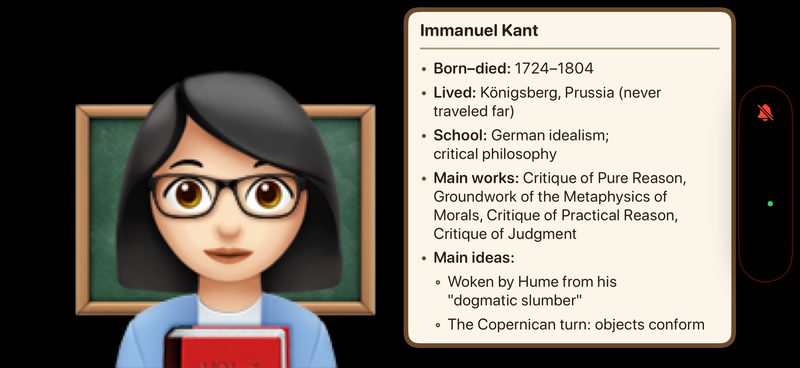
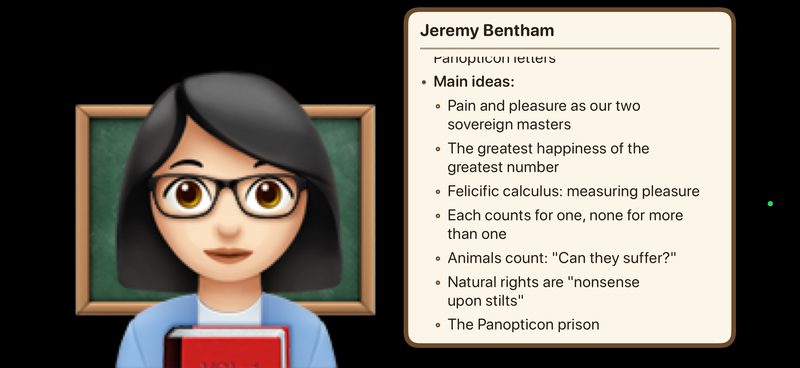
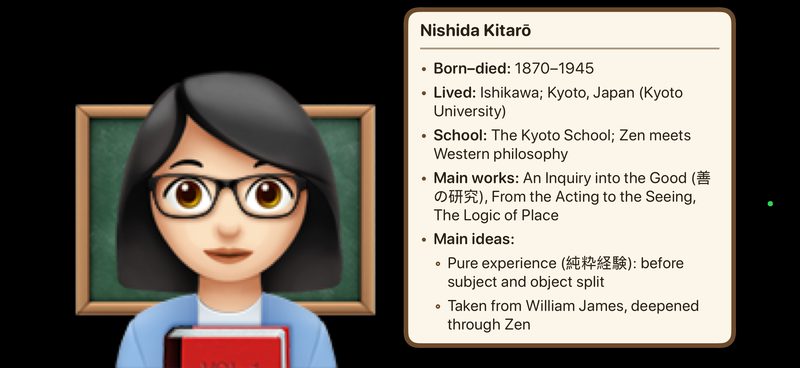
Professor mode: the lecture is spoken; the whiteboard holds the key points, at your own pace.
Several design lessons fell out of a single morning:
- Interruptible is everything. A lecture you can't interrupt is a podcast. The ability to say "wait, stop" and ask a question turns it into a conversation.
- Many channels, each at its own pace. Voice carries the explanation in real time. The whiteboard, captions, and links wait until you look. Nothing scrolls away before you're ready.
- Never leave the student in the dark. Thinking takes a moment. Simple indicators showing that the system heard you and is working remove most of the frustration of waiting.
- The student leads. Our best moments came from our own questions and disagreements, not the prepared material. The tutor's job is to follow up, push back, and occasionally ask questions in return.
- Point outward. The world is already full of excellent free material: Khan Academy, Wikipedia, open courseware, recorded lectures. A good tutor knows when to say "here's a great video on exactly this."
What we plan to build
We're working on a standalone tutoring app based on what we learned: professor mode on its own, for middle school students and up, curious adults, and lifelong learners. It's for anyone who wants to learn at their own pace and in their own direction.
It will rest on a few principles. It will ask students to explain ideas back, since that's where learning sticks. It will bring earlier topics back for review days later. Every claim on the board will be traceable to a source. And it will be affordable worldwide: a few dollars at most, priced by country, and free where that's what it takes.
There are real risks to take seriously: confident mistakes, overreliance, the privacy of young users, and unequal access. None of them is a reason to wait. Each is a design requirement.
Bloom's two sigmas have been out of reach for forty years. We think a patient, interruptible tutor with a whiteboard, available to anyone with an old phone, might finally bring them within reach.